
Imagine waking up in a small apartment in Barcelona, enjoying breakfast while hearing the bustling trams nearby. Or walking through a perfectly clean neighborhood in Berlin, heading to a high-paying tech job. Or maybe enjoying the peaceful countryside of Poland while working in a stable manufacturing role.
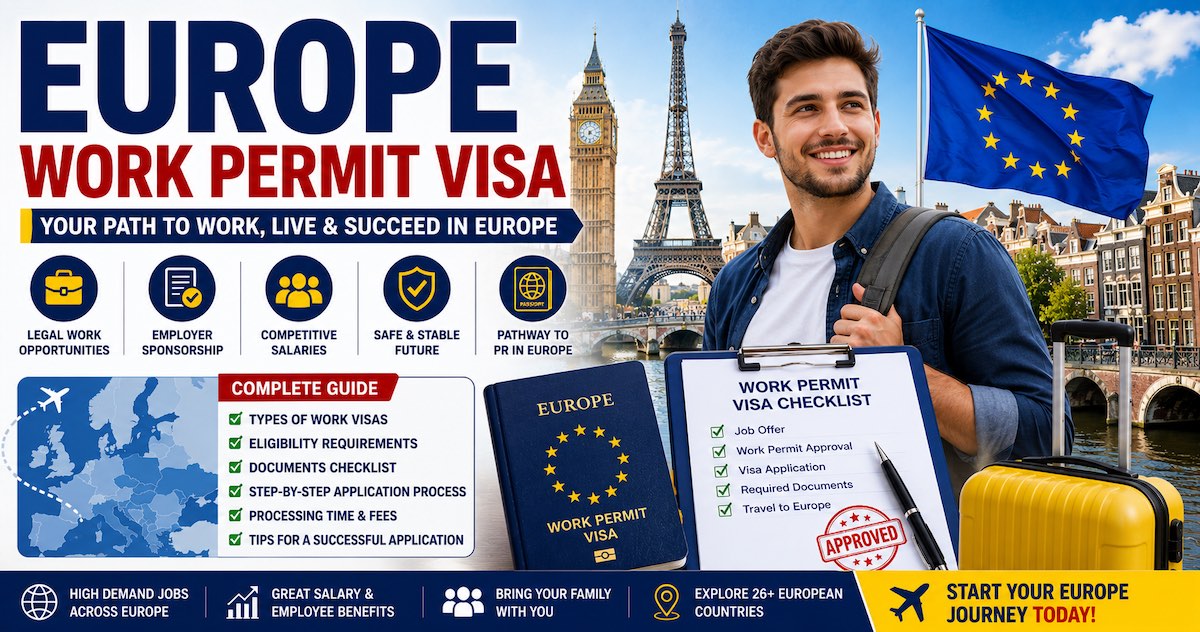
Every year, over 3 million foreign workers move to Europe with legal work permits. From Asian countries like Bangladesh, India, Nepal, and the Philippines to African nations such as Nigeria, Egypt, and Kenya—Europe has become a dream destination because of:
- High salary
- Job security
- Free healthcare (in many countries)
- Strong labor protection laws
- Opportunity for permanent residency
Europe isn’t just a place to work—it’s a place to grow, learn, and build a brighter future.
Types of Europe Work Permits
Europe does not have a single “Europe Work Permit.” Instead, each country has its own work visa rules. However, the main categories are:
1. EU Blue Card
The most prestigious work permit in Europe.
Best for:
High-skilled professionals (IT, engineering, medical, finance)
Benefits:
- High salary (€45,000 to €56,000 minimum in most countries)
- Brings family members
- Path to permanent residency
- Mobility to other EU states
2. National Work Permit Visa
Each European country issues its own work permit based on its labor market needs.
Examples:
- Germany Work Visa
- Italy Decreto Flussi Visa
- Poland Work Permit (Type A)
- Portugal D1 Work Visa
- Spain Work Residence Visa
3. Seasonal Work Visas
Valid for 3–9 months for roles like:
- Agriculture
- Food processing
- Hospitality
Countries offering seasonal visas:
- Italy
- Spain
- France
- Germany
4. Caregiver & Health Worker Visas
Massive shortages across Europe have made caregiver jobs highly in demand.
Countries hiring caregivers:
- Germany
- Italy
- Spain
- Ireland
- Norway
5. Sponsored Work Permits
Employer-sponsored visas where the company handles the paperwork.
Popular in:
- Netherlands
- Germany
- Denmark
- Sweden
Top European Countries Offering Work Permits
Germany
- Europe’s strongest economy
- Requires skilled workers
- Popular EU Blue Card destination
Poland
- Easy work permit rules
- Popular for manufacturing and logistics
- Many South Asian workers live here
Italy
- Uses Decreto Flussi quota system
- High demand for caregivers, agriculture, & construction
Spain
- Regularization pathways
- Hospitality & agriculture hiring heavily
Portugal
- D1 Work Visa
- Growing demand for tech and tourism jobs
Netherlands
- Excellent salary packages
- Huge demand for software engineers
In-Demand Jobs Across Europe
According to the European Labour Authority, Europe faces a shortage in many sectors:
| Job Category | Shortage Level | Countries Hiring |
|---|---|---|
| Caregivers | Very High | Germany, Italy, Spain, Ireland |
| IT/Software | Very High | Netherlands, Germany, Sweden |
| Engineering | High | Austria, Finland, Poland |
| Hospitality | High | Spain, Portugal, France |
| Agriculture | High | Italy, Spain, Poland |
| Logistics/Drivers | High | Germany, Belgium, Poland |
Statistic:
By 2030, Europe will require over 7 million foreign workers to fill labor gaps (EU Report).
Eligibility Requirements for a Europe Work Permit Visa
While each country has specific rules, the common eligibility criteria include:
- A valid job offer from a European employer
- Clean criminal record
- Health insurance
- Relevant qualifications or work experience
- Signed employment contract
- Employer sponsorship documents
Skilled workers (engineers, IT) require degrees, while unskilled jobs (factory, agriculture) require only experience.
Required Documents for Europe Work Permit Visa
You typically need:
- Passport (valid 2+ years)
- Passport-size photos
- Job offer letter
- Work contract
- Sponsorship/Work permit form
- Educational certificates
- Police clearance certificate
- Medical certificate
- Proof of accommodation
- Financial evidence (sometimes)
Step-by-Step Application Process for Europe Work Permit
Here is a simple, clear breakdown:
Step 1: Get a Job Offer
Apply through:
- Company websites
- European job portals
- Recruitment agencies
Step 2: Employer Applies for Work Permit
The employer submits documents to the labor authority of their country.
Step 3: Receive the Work Permit Approval
Once approved, you receive:
- EU Blue Card approval
- Work permit letter
- Nulla Osta (Italy)
- Work contract
Step 4: Apply for Visa at Embassy
Submit:
- Application form
- Passport
- Biometrics
- Fees
Step 5: Visa Processing
Average processing time:
- Germany: 1–3 months
- Italy: 3–6 months
- Poland: 1–2 months
- Spain: 1–3 months
Step 6: Travel to Europe
Once the visa is stamped—pack your bags!
Step 7: Apply for Residence Permit
After arrival, register at:
- Municipality
- Police
- Immigration office
Processing Time & Fees
Costs vary by country:
| Country | Fee | Processing Time |
|---|---|---|
| Germany | €75 | 1–3 months |
| Italy | €116 | 3–6 months |
| Poland | €60–€120 | 1–2 months |
| Spain | €80 | 1–3 months |
| Portugal | €90 | 2–4 months |
| Netherlands | €320 | 1–3 months |
Why Europe Needs Foreign Workers
Fact:
Europe has a declining population and aging workforce.
- The average age in Europe is 44 years
- By 2050, one-third of Europeans will be over age 60
This creates urgent labor shortages in:
- Healthcare
- Agriculture
- Technology
- Construction
- Transportation
Foreign workers are essential to keeping European industries running smoothly.
Real-Life Success Story
Ravi, a 28-year-old from India, applied for a logistics job in Poland. After six months:
- He moved to Warsaw
- Started earning €1200/month
- Brought his wife on a family reunion visa
- Later moved to Germany using his experience
His journey shows how Europe can open long-term career pathways.
Benefits of Working in Europe
- High salaries (€1200 to €5000+)
- Permanent residency options
- Free healthcare in many countries
- Family reunification
- Safe working environments
- Paid holidays (20–30 days per year)
- Opportunity to travel across 26 Schengen countries
Common Mistakes Applicants Make
❌ Submitting incomplete documents
❌ Using fake job offers (leading to visa rejection)
❌ Not preparing for embassy interviews
❌ Believing agents without verification
Always double-check official government websites.
Frequently Asked Questions (FAQs)
1. Can I apply for a Europe work visa without a job offer?
For most countries, you need a job offer. However, Germany offers:
- Job Seeker Visa
- Germany Opportunity Card
These allow you to enter and search for work.
2. How long is the Europe Work Permit valid?
Usually 1 to 2 years, renewable as long as you remain employed.
3. Can my family join me in Europe?
Yes. Most work visas allow:
- Spouse
- Children
- Dependent parents (rare cases)
4. Do I need to know the local language?
Not always, but learning:
- German
- Spanish
- Italian
- Polish
can increase your job chances by 50%.
5. Which European countries are easiest for work visas?
- Poland
- Portugal
- Lithuania
- Czech Republic
- Italy (under Decreto Flussi quota)
These countries have lower skill barriers and simplified processes.
Conclusion
Getting a Europe Work Permit Visa is one of the best decisions you can make for your career and future. Whether you’re aiming for a high-skilled IT role, a caregiver position, or a factory job—Europe offers competitive salaries, social benefits, job security, and long-term residency opportunities.
With the right guidance, proper documentation, and verified job offers, your dream of working and living in Europe is absolutely achievable.